
For software testing professionals with 5 to 15 years of experience, the question isn’t whether experience vs certification in Software Testing matters more. The real question is whether you’ve evolved beyond execution into strategic quality leadership. This article examines what actually drives career growth for mid-career QA professionals and when certifications like ISTQB become strategically valuable.
Experience vs certification in software testing: What Is the Difference?
Experience in software testing means hands-on exposure to real-world testing scenarios including working with defects, automation frameworks, CI/CD pipelines, and production environments. Certification in software testing, such as ISTQB (International Software Testing Qualifications Board), represents structured validation of theoretical knowledge, testing principles, and standardized terminology.
For professionals in their first three years, experience typically matters more than certification because you’re building fundamental execution skills. However, for professionals with 5 to 15 years of experience, the dynamic becomes more strategic. Experience builds execution capability while certification builds structured knowledge and credibility. Career growth after the five-year mark depends primarily on systems thinking and strategic influence, not just accumulating more years or collecting credentials.
Why Do QA Professionals Hit a Career Plateau After 5 Years?
Most QA professionals experience rapid growth during their first three to five years. During this period, you typically learn automation frameworks, API testing, test case design, CI/CD integration, and defect triage. Then something changes. Growth slows, promotions stall, and you become technically strong but not strategically visible. This is the QA career plateau that many mid-level testers experience.
The uncomfortable truth is that ten years of experience can sometimes be two years of experience repeated five times. This is what career experts call the experience trap in software testing. You accumulate time in role without accumulating strategic impact.
The Root Causes of Mid-Level Tester Stagnation
Many professionals with 5 to 10 years of experience plateau because they stay within one domain, focus only on automation execution, never define test strategy, don’t influence architecture decisions, avoid quality metrics ownership, and lack systems thinking in testing. Experience accumulates but impact does not.
This is precisely why the question “experience vs certification in software testing” misses the point. The real question experienced testers should ask is: Have I evolved beyond execution into strategic influence?
The Three Layers of Senior QA Capability
To understand what drives career growth after five years, consider this capability framework that maps to different career stages.
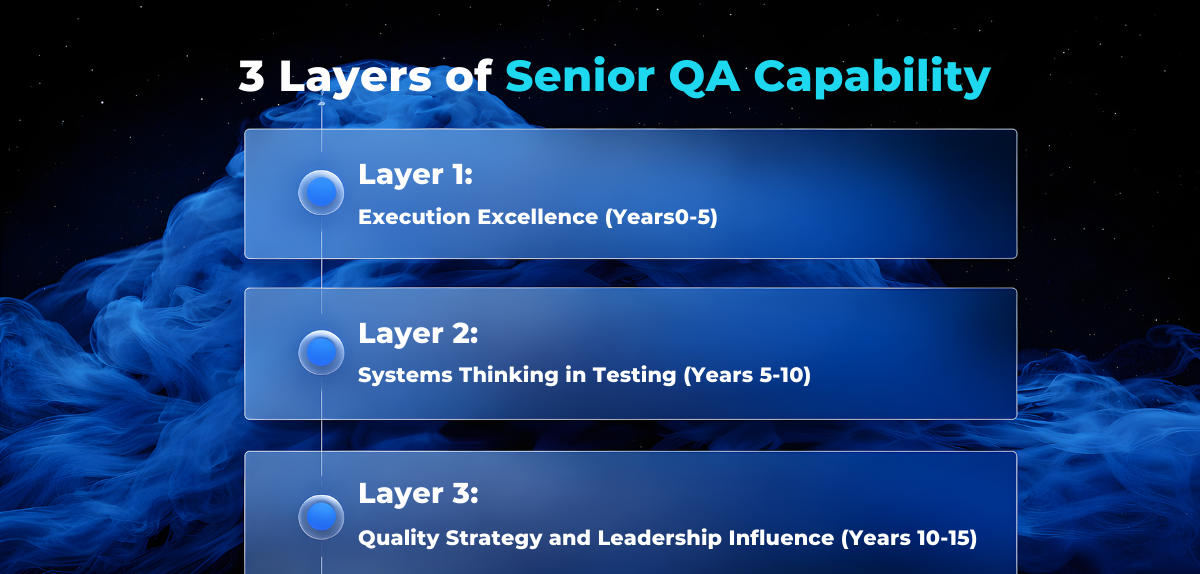
Layer 1: Execution Excellence (Years 0-5)
During your first five years, the focus is on tool proficiency with tools like Selenium, Playwright, and Postman, writing test cases, debugging failures, defect reporting, and automation scripting. At this stage, experience dominates and certification adds minimal value. You need hands-on practice more than theoretical validation.
Layer 2: Systems Thinking in Testing (Years 5-10)
This is where career differentiation begins. Systems thinking in testing includes risk-based testing strategy, architecture-level understanding, observability awareness, CI/CD pipeline optimization, automation ROI modeling, quality metrics interpretation, and cross-functional collaboration.
Certification can reinforce terminology and structured thinking at this level, but it cannot create strategic exposure. The distinction matters because many testers mistake learning terminology for developing strategic capability.
Layer 3: Quality Strategy and Leadership Influence (Years 10-15)
This is leadership territory. Capabilities at this level include designing organization-wide test strategy, quality governance and compliance awareness, cost of quality optimization, influencing product leadership decisions, building quality culture, and scaling automation frameworks strategically.
At this level, experience without structure feels informal and difficult to communicate to stakeholders. Certification without strategic maturity feels shallow and doesn’t translate to actual influence. Senior leaders need both strategic thinking and the ability to articulate it with credibility.
Does ISTQB Matter After 5 Years of Experience?
This is one of the most frequently searched questions by experienced testers. The answer depends entirely on your career direction and organizational context.
ISTQB and similar certifications help moderately when moving to QA Lead roles, significantly in enterprise environments, minimally in startup product companies, considerably in consulting careers, and substantially in regulated industries like finance and healthcare. For senior automation engineers staying in execution-focused roles, certification typically provides low value.
The pattern is clear: certification improves credibility and organizational signaling but rarely improves execution skill. If you’re already strong technically, certification functions as a credential that helps with resume filtering and HR processes rather than a capability builder.
What Are the Benefits of Experience in Software Testing?
Experience provides deep pattern recognition across different types of systems and failures. It builds contextual problem-solving ability where you can quickly assess what testing approach makes sense for a given situation. Experience creates fast debugging capability because you’ve seen similar issues before. It develops practical intuition that helps you identify high-risk areas without formal analysis. Experience also builds domain familiarity that makes you valuable in specialized industries.
Experience builds confidence in your technical abilities. However, confidence is not the same as career acceleration, and this is where many experienced testers get stuck.
What Are the Limitations of Experience Alone?
Experience becomes limiting when it stays execution-focused, avoids architectural influence, ignores metrics and governance, lacks cross-domain exposure, and repeats the same environment patterns without variation. This is the mid-level tester stagnation problem.
If you’ve been writing automated tests in the same tech stack for eight years without expanding into test strategy, architecture discussions, or quality metrics, you have eight years of execution experience but limited strategic experience. Career growth requires strategic exposure, not just more time doing the same activities.
When Does Certification Actually Help Experienced Testers?
Certification may genuinely help experienced testers in specific situations. It provides value when you
- need enterprise credibility in large organizations with formal HR structures
- work in compliance-heavy domains where documented qualifications matter
- transition from individual contributor to QA Manager roles
- plan consulting roles where client credibility is important
- need structured vocabulary alignment to communicate effectively with stakeholders.
Certification acts primarily as a career signaling tool rather than a capability builder. It signals to organizations and hiring managers that you understand structured testing methodology and can speak a common professional language.
The Risks of Over-Relying on Credentials
Over-indexing on certification creates risks including mistaking terminology for competence, spending excessive time on exam preparation instead of strategic work, ignoring real-world complexity that doesn’t fit certification frameworks, and believing certification can replace actual impact and influence.
If your promotion depends solely on obtaining a certificate, the problem is not your knowledge level. The problem is your organizational influence and strategic visibility.
Should You Get Certified Now? A Decision Framework
Use this strategic evaluation to determine if certification makes sense for your specific situation right now.
If you have 5 to 7 years of experience with strong execution skills but weak systems exposure, your recommended focus should be expanding strategic exposure first before pursuing certification. If you have 8 to 10 years and are actively targeting QA Lead roles, combining certification with strategy work makes sense. If you’re on an enterprise leadership track in a large organization, structured certification genuinely helps. If you’re in a startup-focused growth environment, deep technical skills and systems thinking matter more than credentials. If you have consulting ambition, certification significantly improves marketability. If you’re feeling plateaued in your career, you should broaden your scope and strategic exposure before pursuing credentials.
Before pursuing any certification, ask yourself if you can clearly articulate test strategy trade-offs, automation investment ROI, risk prioritization logic, and quality metrics impact. If you cannot articulate these strategic concepts, certification should not be your first move. Strategic growth through expanded responsibilities should be your priority.
How Do You Move from Tester to QA Leader?
Instead of asking “Should I get ISTQB?” experienced testers should ask themselves these strategic questions: Have I owned a test strategy for a product or system? Have I influenced architecture decisions based on testability and quality concerns? Have I measured cost of quality and presented findings to leadership? Have I led cross-functional quality initiatives involving multiple teams? Have I optimized CI/CD quality gates to improve development velocity?
If most answers are no, your growth lever is strategic exposure, not certification. You need opportunities to work on higher-level quality problems before credentials will meaningfully advance your career.
The 24-Month Strategy for Moving Into QA Leadership
Career progression from mid-level tester to QA leader typically requires a 24-month intentional strategy. This strategy involves systematically expanding from execution into strategy, building influence across teams, taking ownership of quality metrics, participating in architecture discussions, and developing the ability to communicate quality trade-offs to non-technical stakeholders.
The professionals who successfully make this transition don’t just accumulate more testing experience. They deliberately seek out strategic responsibilities and build visibility for their quality impact.
Is Experience Enough to Become a QA Manager?
The short answer is no. Execution experience is foundational and necessary, but it’s not sufficient for management roles.
QA managers need governance awareness to work within organizational structures, risk-based decision frameworks to prioritize quality investments, organizational alignment skills to coordinate across teams, budget and resource planning capabilities, and stakeholder communication skills to translate technical quality concerns into business impact.
These capabilities are not taught purely by execution experience. They require intentional evolution and often deliberate exposure to management activities before you have the formal title.
When Certification Makes Sense for Experienced Testers
Certification makes strategic sense when you want credibility in structured enterprises with formal career bands, when you need formal validation for leadership roles that have credential requirements, when your organization explicitly values band-based credentialing for promotions, and when you plan to consult or train others where external credibility matters to clients.
Certification does not make strategic sense when you are still execution-focused without strategic responsibilities, when you lack strategic exposure to architecture and quality metrics, and when you are using certification to avoid the deeper growth work of expanding your scope and influence.
Frequently Asked Questions About Experience vs Certification in Software Testing
Is ISTQB Worth It for Experienced Testers?
ISTQB can improve your credibility and vocabulary alignment with industry-standard terminology, but it does not replace strategic experience. For experienced testers in execution-focused roles, the ROI is typically low. For those moving into leadership or working in enterprise environments, it can provide meaningful value as a signaling credential.
Does Certification Matter in Software Testing?
Certification matters more in enterprise and regulated environments than in startups. In industries like finance, healthcare, and government contracting, formal credentials carry significant weight. In fast-moving product companies and startups, demonstrated capability and strategic thinking typically matter more than certificates.
Can Experience Replace Certification?
Yes, in execution-heavy roles where hands-on technical skill is the primary requirement. No, when organizational signaling is required for promotions or client credibility. The answer depends entirely on your organizational context and career goals.
Why Do Mid-Level Testers Plateau in Their Careers?
Mid-level testers plateau because they stop evolving beyond automation and execution. They become comfortable with technical skills but don’t develop strategic thinking, don’t take ownership of quality metrics, don’t influence architecture decisions, and don’t build cross-functional relationships that create career opportunities.
How Do You Move from Tester to QA Lead?
You move from tester to QA lead by expanding into systems thinking, taking ownership of test strategy rather than just executing tests, building influence across development and product teams, and developing the ability to communicate quality trade-offs to stakeholders. This transition requires deliberately seeking strategic responsibilities, not just waiting for them to be assigned.
Is Certification Required for QA Manager Roles?
Not universally. Whether certification is required depends on organization structure and governance standards. Some enterprise organizations have explicit credential requirements for management bands. Many other organizations care more about demonstrated leadership capability and strategic thinking than formal certifications.
What Differentiates Senior Testers from Mid-Level Testers?
Senior testers are differentiated by strategic thinking about quality trade-offs, architecture awareness that allows them to influence design decisions, and quality influence that extends beyond their immediate team. Senior testers think in terms of organizational quality culture, not just test execution.
Does Certification Accelerate Promotion?
Certification may support HR processes and help you meet formal requirements, but it rarely drives promotion alone. Promotions are typically driven by demonstrated impact, strategic thinking, and leadership capability. Certification can help you check a box, but it won’t substitute for actual strategic contribution.
What Actually Drives QA Career Growth After 5 Years

Experience builds execution capability and technical confidence. Certification builds credibility and provides structured knowledge frameworks. Systems thinking builds leadership capability and strategic influence.
Career plateaus happen when execution becomes comfortable and you stop expanding into strategy. Senior growth requires strategic thinking and organizational influence, not just repetition of the same technical activities.
After 5 years in QA, the question is no longer “Experience vs certification—which is better?” The real career-defining question is: “Am I evolving from tester to quality strategist?” Your answer to that question determines your career trajectory far more than any certification or additional years of execution experience.
The professionals who advance beyond mid-level QA roles are those who recognize that strategic exposure, influence, and systems thinking are the actual drivers of career growth, not credentials or years of service alone.
