
Everyone asks about Manual vs Automation Testing. What works and what is relevant? Let’s go deeper in it.
Manual testing is about thinking. Automation testing is about scaling certainty. Most teams fail by confusing the two.
Why the Manual vs Automation Debate Won’t Die
We’ve heard “manual testing is dead” every year for 15 years.
When Selenium matured. Automation would replace testers. When CI/CD became standard. Manual testing would disappear. When DevOps reshaped releases. QA would become fully automated. Now with AI writing code. Testers would be obsolete.
Yet here we are in 2026. Manual testing still matters.
The Real Reason Why
Every increase in delivery speed increases system complexity.
Modern software challenges:
- Microservices architectures
- Distributed API ecosystems
- Feature toggles and A/B tests
- AI integrations
- Continuous deployment cycles
Automation accelerates execution. It doesn’t eliminate uncertainty.
The question isn’t “automation vs manual testing” as competitors.
The question is: Does your testing strategy understand risk?
Manual vs Automation Testing: Is Manual Testing Still Relevant in 2026?
Yes. But not the way it was 10 years ago.
If “manual testing” means repetitive script-following—that’s shrinking fast.
If it means exploratory thinking, contextual validation, and user-centered evaluation—that’s growing in value.
When Manual Testing Wins in 2026
1. Rapidly Evolving Products
Requirements change constantly in startups and experimental features.
The automation trap: Teams automate unstable flows too early.
The result:
- Scripts rewritten every sprint
- Flaky pipelines nobody trusts
- Engineers ignoring test failures
Manual validation isn’t outdated here. It’s pragmatic.
2. Exploratory Testing
Automation confirms what we expect to happen.
Exploratory testing asks different questions:
- What if this breaks under edge input?
- What happens during latency spikes?
- Does this interaction feel intuitive?
- What assumptions did we miss?
You can’t script curiosity. And curiosity finds critical defects.
3. User Experience Validation
Automation tells you a button works.
It can’t tell you:
- The button placement is confusing
- Users experience cognitive friction
- The flow feels frustrating
- Design assumptions are wrong
In 2026, products compete heavily on UX. Manual testing remains vital here.
4. Testing AI-Generated Code
Here’s the irony: AI in testing is advancing. AI is also writing production code.
But AI-generated code introduces:
- Subtle logical gaps
- Contextual misunderstandings
- Edge cases AI didn’t consider
Automation verifies known paths. Humans detect when something feels off.
The more AI we add, the more validation discipline we need.
Key Insight
Automation increases scale. AI increases complexity. Both increase the need for strong human testing judgment.
Why “Manual vs Automated Testing” Is the Wrong Question
The automation vs manual testing debate becomes emotional. It shouldn’t be.
Automation is not a strategy. It’s a capability.
Testing has always been about managing risk—not maximizing tool usage.
The Coverage Trap
We’ve seen organizations chase automation coverage like trophies:
- “90% automated!”
- “95% automated!”
Yet production incidents still happened.
Why? Coverage doesn’t equal confidence.
Confidence comes from understanding:
- What matters most to users
- Where failure hurts the business
- Which risks remain unknown
Manual and automation testing aren’t opposites. They’re complementary mechanisms in quality engineering.
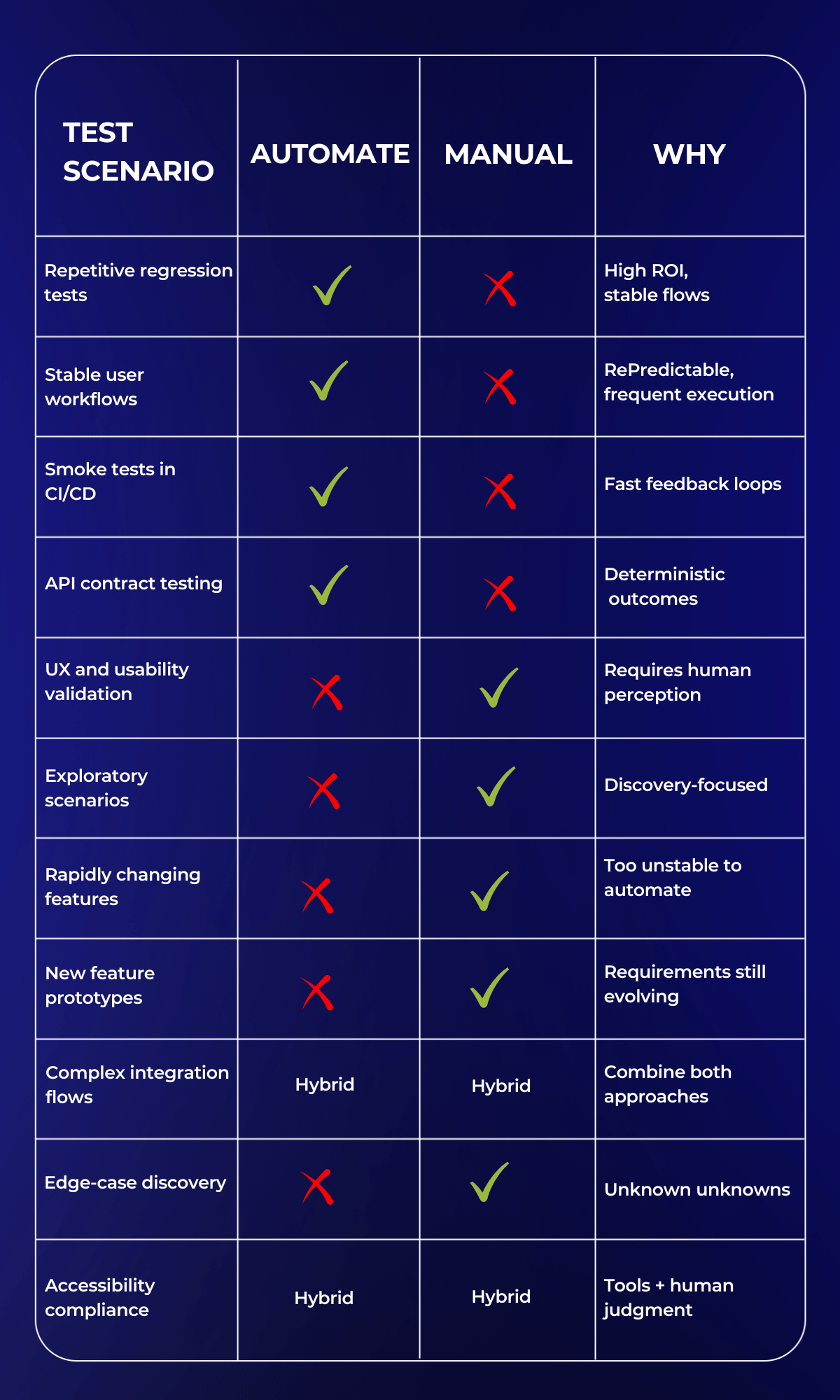
Automation Decision Framework
Before automating anything, answer these five questions:
1. Is It Stable?
Unstable features create unstable automation.
If requirements change weekly, automation becomes expensive maintenance.
2. Will It Run Frequently?
High-frequency regression justifies automation investment.
One-time tests don’t need automation. Daily regression tests do.
3. What’s the Business Risk?
Critical revenue flows deserve automation redundancy.
Prioritize automating:
- Payment processing
- User authentication
- Core product features
- Checkout flows
4. What’s the Maintenance Cost?
Automation maintenance cost is real. Ignore it and your suite becomes noise.
Consider:
- How often will selectors break?
- How complex is the test data setup?
- Who will maintain these tests?
5. Does ROI Make Sense Long-Term?
Not for the next sprint—but for the next year.
If stability + frequency + risk = high → Automate. If uncertainty dominates → Stay manual or hybrid.
Strategic Principle
Automating everything is naive. Automating strategically is leadership.
Real-World Testing Strategies by Industry
Startup Teams
Approach: Heavy manual exploratory testing. Lightweight automation.
Why: Fast iteration matters more than comprehensive automation.
Automation focus: Critical paths only (signup, login, core feature).
Enterprise SaaS
Approach: Robust regression automation integrated into CI/CD.
Reality: Exploratory testing sessions still uncover high-impact defects.
Balance: 70% automated regression, 30% manual exploration.
AI-Driven Applications
Approach: Manual validation ensures outputs align with business logic and ethics.
Challenge: AI behavior is probabilistic, not deterministic.
Strategy: Automate monitoring. Manually validate edge cases.
Microservices Ecosystems
Approach: Automation verifies service contracts. Manual testing investigates integration nuance.
Key insight: Contract tests catch breaking changes. Humans catch business logic gaps.
Industry Pattern
Hybrid approaches outperform rigid philosophies across all sectors.
Testing Tools and Technology in 2026
Leading Automation Frameworks
Modern test automation tools:
- Playwright – Cross-browser, auto-wait, powerful API
- Cypress – Developer-friendly, fast feedback
- Selenium – Mature ecosystem, wide language support
AI in Testing
New capabilities:
- AI-generated test cases from requirements
- Intelligent defect clustering and prediction
- Automated test data generation
- Self-healing test scripts
- Visual regression with AI comparison
The Reality Check
Tools don’t replace thinking. They amplify it.
Without strong test design skills, even the best automation tools underperform.
Benefits of Manual Testing in 2026
Manual testing delivers unique value:
Encourages deep product understanding – Hands-on interaction builds intuition
Identifies usability friction – Automation can’t feel frustration
Adapts quickly to change – No script maintenance overhead
Strengthens analytical reasoning – Active problem-solving keeps skills sharp
Surfaces contextual risks – Understanding business context matters
Core truth: Manual testing sharpens judgment. Judgment remains irreplaceable.
Limitations of Manual Testing
We should be honest about the downsides.
Manual regression at scale is inefficient – Time-consuming and slow
Repetition leads to fatigue – Humans miss details after 100th execution
Consistency suffers – Different testers may interpret tests differently
Difficult to scale – Can’t parallelize human attention
Knowledge silos – Testing knowledge often lives in people’s heads
This is where automation excels.
The mistake isn’t choosing automation. The mistake is abandoning manual thinking.
Implementation: Hybrid Testing Model for 2026
Quality maturity evolves through predictable stages:
Level 1: Manual-Heavy Testing
Characteristics:
- Exploratory focus
- Rapid validation
- Minimal automation
Best for: Early-stage products, MVPs, proof-of-concepts
Level 2: Basic Regression Automation
Characteristics:
- Stable, repetitive flows automated
- Manual testing for new features
- Ad-hoc automation
Best for: Growing products with stable core features
Level 3: CI/CD Integration
Characteristics:
- Automation embedded in deployment pipelines
- Automated smoke tests block bad builds
- Test results visible to all teams
Best for: Mature products with regular releases
Level 4: Risk-Based Hybrid Strategy
Characteristics:
- Automation decisions guided by ROI and business impact
- Strategic mix of manual and automated testing
- Data-driven testing prioritization
Best for: Enterprise products with complex risk profiles
Level 5: AI-Augmented Quality Engineering
Characteristics:
- Automation + AI assistance + human oversight
- Predictive defect analysis
- Intelligent test generation and maintenance
Best for: Cutting-edge teams with strong foundations
Reality check: Most high-performing teams operate at Level 3 or 4.
Level 5 requires strong foundations—not tool obsession.
The Future of QA Careers in 2026
Is Manual Testing Still a Good Career?
If it means only manual script execution – The market is tightening.
If it means strong test design, risk analysis, exploratory thinking, and automation literacy – Demand remains strong.
What Employers Want in 2026
The future of QA belongs to professionals who:
Understand automation strategy – Not just write scripts
Think in terms of risk-based testing – Prioritize what matters
Collaborate with AI tools – Augment, don’t compete
Combine analytical depth with technical capability – Both sides matter
Communicate quality trade-offs – Influence product decisions
The Title Shift
“Manual Tester” → “Quality Engineer” → “Quality Engineering”
The core skill remains: Disciplined critical thinking.
Frequently Asked Questions
1. Is manual testing still relevant in 2026?
Yes. Manual testing remains critical for exploratory testing, UX validation, early-stage development, and testing AI-generated code. The role has evolved from script execution to strategic validation and risk analysis.
2. Will automation replace manual testers completely?
No. Automation replaces repetitive tasks, not analytical thinking. As systems become more complex with AI and microservices, human judgment becomes more valuable, not less.
3. What cannot be automated in testing?
Four things resist automation:
- Usability evaluation – Requires human perception
- Exploratory discovery – Unknown unknowns
- Contextual judgment – Business logic understanding
- Unpredictable human behavior – Real user experience
- Is manual testing a good career choice in 2026?
Manual-only roles are shrinking. Hybrid QA roles combining manual expertise with automation skills remain strong. The key is evolving from execution to strategy.
5. Should manual testers learn automation?
Absolutely yes. Automation literacy increases:
- Career resilience
- Strategic value to teams
- Salary potential
- Job opportunities
Start with one framework (Playwright or Cypress) and basic programming (Python or JavaScript).
6. Does AI reduce the need for testers?
No—it increases it. AI-generated code introduces new complexity requiring validation. AI tools also augment testing capabilities, making skilled testers more productive.
7. How do you decide what to automate?
Evaluate five factors:
- Stability – Are requirements stable?
- Frequency – Will it run often?
- Risk – What’s the business impact?
- Maintenance cost – Can we sustain it?
- ROI – Does it make sense long-term?
8. What is the future of QA and testing?
Risk-driven, automation-enabled, AI-augmented quality engineering.
The future combines:
- Strategic automation based on business risk
- AI tools for test generation and maintenance
- Human expertise for exploratory testing and validation
- Continuous learning and adaptation
Final Takeaways:
Manual vs automation testing in 2026 is not binary – Both play strategic roles
Automation improves scale; manual testing improves insight – Different strengths
AI increases complexity, not certainty – More validation needed, not less
Hybrid testing models outperform extremes – Strategic balance wins
Strongest QA professionals combine automation skill with investigative thinking – Both sides matter
What’s Next in Your Testing Journey?
If you’re building a testing strategy: Start with risk. What matters most? Automate that first.
If you’re a manual tester: Learn one automation framework. Start small. Build confidence.
If you’re already automating: Add manual exploratory sessions. You’ll find things your scripts miss.
The goal isn’t perfection. It’s pragmatic quality
