Today, the best AI tools for software testing 2026 are no longer just adding AI as a feature — they are reshaping how QA teams design, execute, maintain, and scale testing. Software testing has changed more in the last two years than in the decade before that. AI is no longer a layer on top of testing tools; it is becoming the foundation of how modern testing is planned and delivered.
The numbers back this up. According to Gartner, by 2027, 80% of enterprises will have integrated AI-augmented testing tools into their software engineering toolchain, up significantly from just 10% in 2022. And the pressure driving this isn’t academic -a Leapwork study found that only 16% of organisations believe their current testing practices are efficient.
If you’re evaluating AI testing tools right now -or wondering why the ones you have aren’t delivering -this guide is for you. We’ve pulled from Gartner’s AI-Augmented Software Testing market research, QA Wolf’s 2026 tool analysis, Scandium’s platform guide, and TestCollab’s AI test case generation roundup to give you a clear, sourced view of what’s actually worth your time in 2026.
Jump to:
- Why AI Testing Tools Are No Longer Optional
- How We Evaluated These Tools
- The Best AI Tools for Software Testing in 2026
- How to Choose the Right Tool for Your Team
- What This Means for QA Professionals
- FAQs
Why AI Testing Tools Are No Longer Optional in 2026
The Problem Traditional Automation Can’t Solve Anymore
Scripted test automation was built for a world where UIs changed slowly and releases were measured in weeks or months. That world is gone. Teams shipping daily are dealing with test suites that break every time a developer renames a button or restructures a form. The result is a brutal maintenance tax – engineers spending 20–30% of their QA bandwidth fixing brittle locators, not building new coverage.
The gap between release speed and test coverage has become the defining pain point for QA teams in 2026. New vendors continue to enter the AI testing market riding the wave of AI hype, while established vendors are extending their offerings organically or through acquisitions -making it difficult for engineering leaders to navigate a constantly evolving landscape where many vendors offer wide-ranging capabilities increasingly powered by AI.
From Scripted to Intelligent: How the Category Evolved
The evolution happened in three stages:
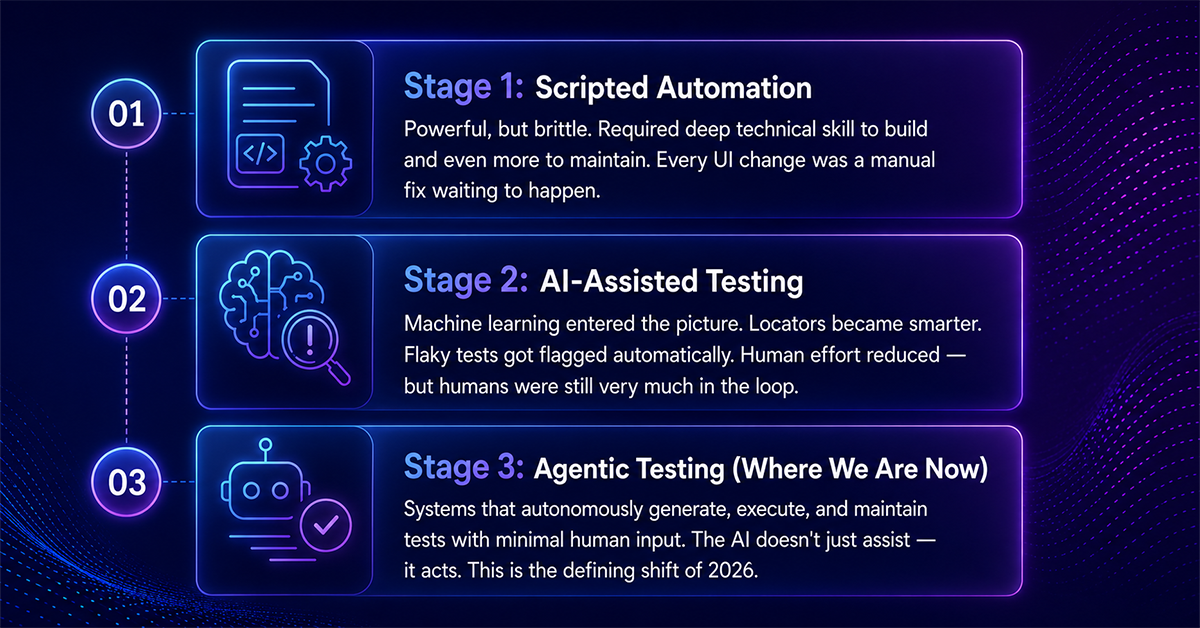
Gartner defines AI-augmented software testing tools as context-aware, data-driven, and increasingly autonomous tools that enable software engineering leaders to deliver higher-quality products faster. That’s the benchmark to hold tools to -not just whether they use AI, but whether they’re genuinely context-aware and adaptive.
What AI Actually Brings to Software Testing in 2026
AI-augmented testing tools provide value through greater efficiency in the creation and maintenance of test assets, helping teams optimise test efforts and receive early feedback about the quality of release candidates. In practical terms, the real capabilities worth paying attention to are:
AI test case generation from requirements, user stories, Jira tickets, screenshots, or live URLs -cutting test authoring time from hours to minutes. Self-healing test automation that automatically updates broken locators when UI elements change, without manual intervention. Predictive defect detection using historical test patterns to flag high-risk areas before they fail in production. Intelligent test prioritisation that ensures the most critical tests run first within compressed CI windows. Root cause analysis that classifies failures by type -code defect, test issue, environment problem, or transient noise -before your team even opens a terminal.
According to Gartner, test creation and maintenance is the most fertile ground for AI augmentation, and one of the areas seeing the greatest innovation and competition.
How We Evaluated These Tools
The AI testing tools market is full of credible-sounding claims. We cut through them by evaluating on criteria that actually matter in production.
We assessed each tool on the depth of its AI capability -not just whether it has “AI” in the marketing copy, but whether the intelligence is genuine and differentiated. We examined self-healing maturity, specifically whether a tool updates the underlying test code or simply adapts behaviour at runtime to avoid failures. We looked at CI/CD integration, because a testing tool that doesn’t fit your pipeline creates a parallel workflow, not a solution. We considered adoption curve -from fully no-code to code-required -because the right tool for a SDET is not always the right tool for a QA lead with no automation background. We factored in enterprise readiness: SSO, RBAC, audit trails, compliance posture. And we cross-referenced real peer ratings from the Gartner Peer Insights market for AI-Augmented Software Testing Tools alongside independent reviews from QA Wolf, Scandium, and TestCollab.
Coverage breadth also mattered. Tools covering only web UI were evaluated differently than platforms supporting web, mobile, API, and desktop in a single workflow.
The Best AI Tools for Software Testing in 2026
1. TestCollab (QA Copilot) -AI Test Case Generation with Human Approval Built In
TestCollab’s QA Copilot is purpose-built for AI test case generation. It generates structured test cases -complete with steps, expected results, and edge-case scenarios -from five input types: natural language prompts, Jira user stories, requirements documents, application screenshots, and live URLs. AI drafts are placed in a review queue where testers can approve, edit, or reject each proposed case before it enters the test suite.
What separates TestCollab from standalone generation tools is that the generated test cases live inside a full test management platform. Once approved, test cases can be automated with one click -QA Copilot converts plain-English test cases into runnable automation, handles waits and assertions, and auto-heals when the UI changes. The full workflow from generation to execution to reporting happens in one platform with full requirements traceability.
Who it’s best for: QA teams that want AI-assisted test generation with a human-in-the-loop approval workflow -particularly in regulated or compliance-sensitive environments. Standout AI feature: Jira integration with TF-IDF similarity matching that automatically surfaces related requirements, so generated test cases cover feature interactions, not just individual stories in isolation. Honest limitation: Stronger on test case generation and management than on autonomous execution; teams needing full E2E automation at scale will want to pair it with a dedicated execution tool. Pricing: Free trial available; paid plans scale by team size.
2. Scandium -Unified AI Testing Suite with Autonomous Testing Agent
Scandium approaches QA as a system -one that includes execution, intelligence, and coordination. Most teams today are forced to combine multiple tools to achieve this: one for automation, another for test management, and increasingly another for AI-driven insights. The result is fragmentation. Scandium takes a different approach by bringing these layers together into a unified, AI-powered suite.
At its core is a no-code automation platform covering web, mobile, and API testing. Above that sits Rova AI, Scandium’s autonomous testing agent. With Rova AI, the model shifts from writing tests to defining outcomes. Instead of specifying steps, teams can describe what should happen -or even tag Rova AI directly in a Jira or Linear ticket. From there, it reads the context, extracts testable goals, explores the application, executes validation, and reports back with detailed evidence. This is goal-driven testing, not just automation.
Who it’s best for: Teams that want to move from scripted automation toward autonomous, goal-driven testing without managing multiple disconnected tools. Standout AI feature: Rova AI -an autonomous testing agent that reads Jira tickets and independently validates outcomes, not steps. Honest limitation: As a newer unified platform, breadth is a strength but depth in specific areas (e.g., enterprise compliance, native mobile) may not yet match specialised tools. Pricing: Free tier available; contact for team and enterprise pricing.
3. QA Wolf -Agentic Automated Testing with Deterministic Code
QA Wolf is the only Agentic Automated Testing platform that generates production-grade Playwright and Appium code from natural language prompts. The output is real test code that your team can review, version, and run in CI/CD. Execution is determined by code rather than adjusted dynamically while the test runs, which keeps tests deterministic and auditable.
The self-healing here is meaningfully different from most tools. QA Wolf follows a diagnosis-first approach, analysing execution logs, screenshots, and other artefacts before updating the underlying Playwright or Appium code -rather than adapting behaviour during execution to keep tests passing. That distinction matters enormously at production scale.
Who it’s best for: Teams needing production-grade, auditable E2E coverage for complex web and mobile applications with backend dependencies or multi-user flows. Standout AI feature: Agentic maintenance that diagnoses root cause before updating real test code -not runtime adaptation. Honest limitation: Enterprise-oriented pricing; best suited to mid-size and larger engineering teams. Pricing: Contact for pricing.
4. Mabl -Low-Code Continuous Testing for Agile Teams
Mabl is built for Agile teams moving fast. It uses machine learning models trained on your application’s UI history to predict which elements are likely to change, flags them proactively, and applies self-healing before tests break. Mabl focuses on improving test reliability using machine learning, helps reduce flaky tests, and integrates well into CI/CD workflows.
Test creation happens through a visual builder or screen recording, and the platform supports visual change detection alongside functional test automation.
Who it’s best for: Mid-size Agile teams wanting AI-driven test stability with fast time-to-coverage. Standout AI feature: ML-based element change prediction -the tool anticipates instability before tests break. Honest limitation: Tests execute in Mabl’s proprietary environment; coverage strategy and long-term maintenance remain your team’s responsibility. Pricing: Contact for pricing.
5. Applitools -Visual AI Testing at Scale
Applitools is the specialist for one specific, undervalued problem: what the user actually sees. Its Visual AI engine compares screenshots against approved baselines across browsers and devices, filtering out acceptable rendering noise while catching meaningful visual regressions. It integrates via SDK with Selenium, Playwright, Cypress, and Appium.
Teams add SDK calls to frameworks to define visual checkpoints. Applitools then handles cross-browser and cross-device visual validation at scale.
Who it’s best for: Design-critical applications where pixel-level accuracy across browsers and devices is a quality requirement. Standout AI feature: AI-powered screenshot comparison that distinguishes genuine regressions from rendering variations. Honest limitation: Visual validation layer only -requires existing automation to supply the underlying test workflow. Pricing: Plans start at $969/month; free trial available.
6. Tricentis Tosca / qTest -Enterprise-Grade, Compliance-Ready
Tricentis covers both ends of the enterprise testing stack. Tosca handles end-to-end test automation with AI-driven test case generation and maintenance. qTest is a scalable test management platform integrating with Jira, Selenium, Jenkins, and the full DevOps toolchain.
Katalon Platform, which shares the Tricentis ecosystem, is an AI-augmented software quality platform that unifies the entire functional testing lifecycle -from manual testing and automation to execution, analytics, and production insights -enabling QA teams to establish a centralised system of record for governance. Tricentis Tosca adds the compliance posture and model-based testing that regulated industries require.
Who it’s best for: Large enterprises in finance, healthcare, or other regulated industries where traceability and audit trails are non-negotiable. Standout AI feature: GenAI-powered test artifact generation across plans, cases, and automation scripts. Honest limitation: Significant implementation complexity and onboarding time; not suited for small or fast-moving teams. Pricing: Enterprise contracts; contact for pricing.
7. Testsigma -Natural Language Testing, No Code Required
Testsigma is a cloud-based test automation platform that uses natural language processing as its primary test authoring method. Its AI assistant, Atto, helps teams write test steps in plain English, which the platform converts into executable automation. It covers web, mobile, desktop, Salesforce, APIs, and databases with native integrations across 30+ CI/CD and project management tools.
Who it’s best for: Teams with limited automation engineering resources who still need broad coverage across multiple surfaces. Standout AI feature: Genuine natural language test authoring -no coding required at any stage. Honest limitation: Complex edge cases and multi-system flows may require additional configuration beyond plain-English prompts. Pricing: Contact for pricing; free trial available.
8. BrowserStack -Real-Device Cloud Testing with AI Optimisation
BrowserStack provides cloud-based testing across real browsers and devices at scale, with an AI layer handling visual validation, test optimisation, and flakiness detection. BrowserStack appears in Gartner’s Peer Insights market for AI-Augmented Software Testing Tools, and its 2026 platform has expanded test observability features that surface flaky tests and execution bottlenecks across distributed CI pipelines.
Who it’s best for: Teams needing broad device and browser coverage with AI-assisted execution diagnostics. Standout AI feature: AI-powered flakiness detection and test optimisation across large, distributed test runs. Honest limitation: Primarily an execution infrastructure and validation layer -test authoring and coverage strategy are still your team’s job. Pricing: Plans start at $199/month; free trial available.
9. Parasoft SOAtest -AI-Augmented API and Microservices Testing
Parasoft SOAtest is now AI-augmented, streamlining API, web service, and microservice testing with intelligent automation. AI-powered features include natural language test generation, smart parameterisation, and machine learning-driven test impact analysis to optimise execution. The agentic AI assistant helps create and maintain tests without scripting, while Change Advisor automates updates from API schema changes.
Who it’s best for: Teams with complex API and microservices architectures needing intelligent test impact analysis. Standout AI feature: Change Advisor -automatically propagates updates when API schemas change, eliminating manual test rewrites. Honest limitation: API-focused; not a full-stack UI testing solution. Pricing: Enterprise contracts; contact for pricing.
10. GitHub Copilot -The Developer’s AI for Test Writing
GitHub Copilot isn’t a dedicated testing tool, but its test generation has matured significantly in 2026. Copilot analyses surrounding files and patterns to generate unit, integration, or E2E test examples that live directly in your repository. It integrates with VS Code, JetBrains, and other major IDEs.
Who it’s best for: Developer-led teams who want AI test suggestions inside their existing editor without adopting a separate platform. Standout AI feature: Repository-wide context awareness -generates tests that reflect your actual codebase, not generic templates. Honest limitation: Not a standalone testing tool -execution, CI integration, maintenance, and coverage strategy remain entirely with your team. Pricing: Free tier available; paid plans from $10/month per user.
11. Functionize -Codeless Automation with Adaptive Execution
Functionize uses machine learning and NLP to create and maintain functional tests. Rather than recording user interactions, it analyses the application under test to build an ML model of the software, then uses that model to generate and adapt tests. Teams can create tests using natural language commands, and the platform’s ML engine handles element identification and test stability.
Who it’s best for: Teams prioritising natural language test creation and hands-off element maintenance. Standout AI feature: Application ML model -Functionize builds an understanding of your software, not just its selectors. Honest limitation: Non-deterministic execution -behaviour is interpreted at runtime rather than defined in fixed test code. Pricing: Contact for pricing; free trial available.
12. Healenium -Open Source Self-Healing for Selenium and Playwright
For teams committed to open-source stacks or working within tight budgets, Healenium is worth knowing. It’s a library that adds self-healing capability to existing Selenium and Playwright suites, automatically finding alternative locators when elements change. It doesn’t replace a commercial platform, but it meaningfully reduces locator maintenance overhead.
Who it’s best for: Teams using Selenium or Playwright who want self-healing without a commercial platform.
Standout AI feature: Automatic locator fallback based on element properties -no code rewrites required.
Honest limitation: Basic self-healing only -no test generation, coverage analytics, or CI observability.
Pricing: Free and open source.
How to Choose the Right AI Testing Tool for Your Team
Start With the Pain, Not the Hype
Before you open any demo calendar, answer this: what is actually breaking your workflow right now? Flaky tests eating your CI time? Every UI change causing a maintenance sprint? Coverage gaps you can’t close with current headcount? Selecting the best AI testing tool depends on your team’s specific needs. The clearest way to narrow the field is to name the specific problem you’re solving -then find the tool built to address it.
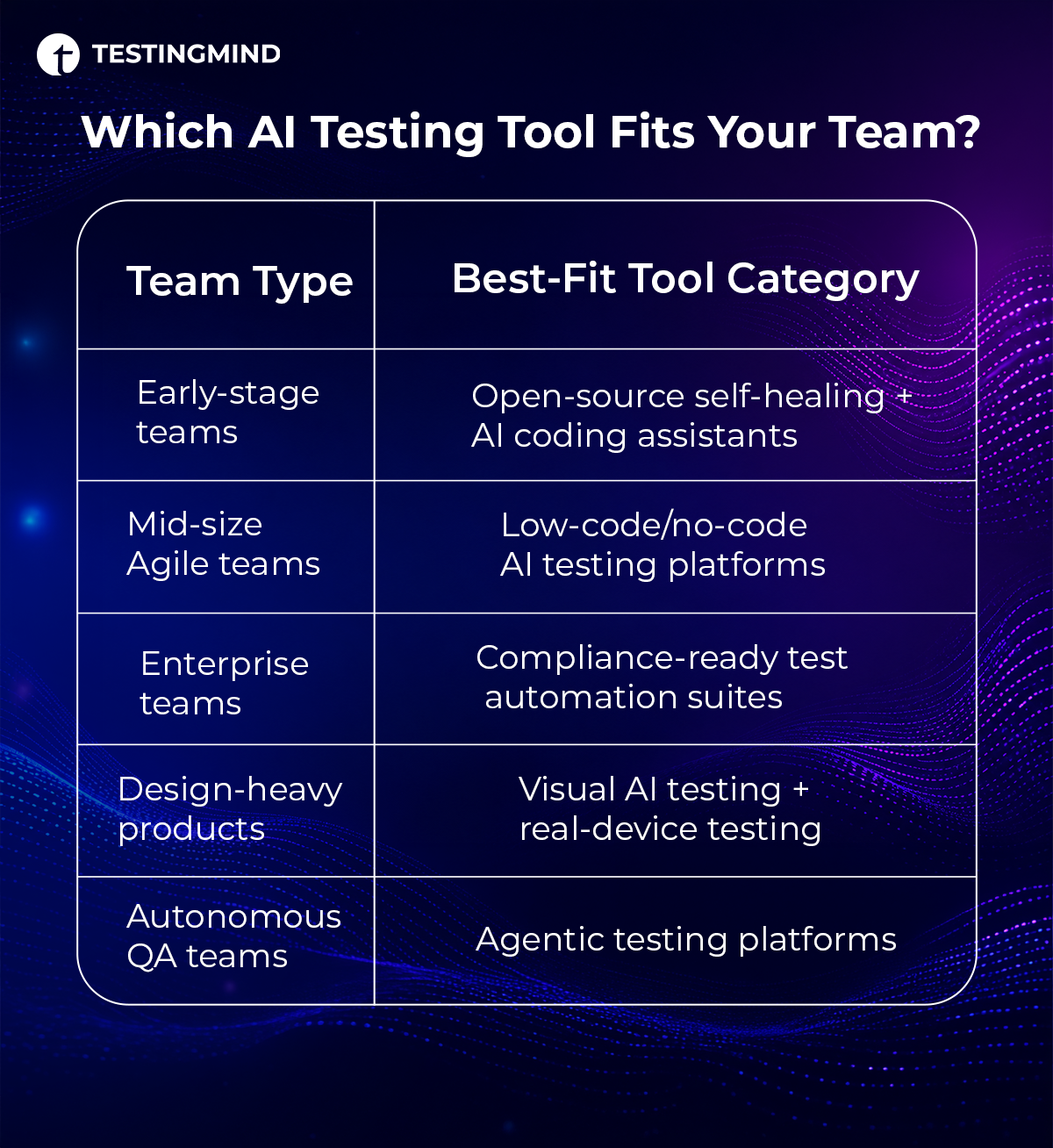
Match the Tool to Your Team’s Maturity
Five Questions to Ask Before You Buy
Before signing a contract, get clear answers to these: Does the tool generate test code your team owns, or does it execute tests in a proprietary environment? Does it integrate natively with your existing CI/CD pipeline, or does it require a parallel workflow? When the AI produces an incorrect result -and it will -how does the tool surface that, and who fixes it? If your industry requires compliance, audit trails, or regulatory testing, look for tools with human-in-the-loop workflows. And finally: if you cancel the subscription, what do you walk away with?
What AI Testing Means for QA Professionals
Here is what rarely gets said in these roundups: the tools are not the story. How your team works with them is.
Despite all the buzz about autonomous testing, we are far from a point where testing can be done entirely without human input. AI-augmented tools can assist in test generation and maintenance, but human validation and oversight remains necessary to ensure tests are accurate and relevant. A Leapwork study found that 68% of C-Suite executives believe human validation will continue to be essential in the quality assurance process.
The model that works is a partnership: humans set the strategy, AI handles the execution volume, and humans make the final quality call. AI-generated test cases are a strong starting point, but your team’s domain knowledge is irreplaceable -use the generated cases as a foundation and refine them based on your understanding of the product.
The QA engineers who will be most valuable in the next three years are not those who use AI tools, but those who understand how AI systems fail -who can spot when self-healing has masked a real regression, when a passing test suite is hiding a business risk, and when a tool’s confidence is misplaced. That judgment is not something any platform can automate.
At Testingmind, this is exactly the conversation our community is built around. Not just which tools to use, but how to build QA practices that are genuinely durable as both the tools and the applications they test keep changing.
Frequently Asked Questions
What are the best AI tools for software testing in 2026?
The strongest options in 2026 include TestCollab’s QA Copilot for AI test case generation with human oversight, Scandium for unified no-code and autonomous testing, QA Wolf for agentic automated testing with deterministic Playwright/Appium code, Mabl and Testim for AI-driven continuous testing, Applitools for visual regression, Tricentis for enterprise compliance, and Testsigma for no-code natural language test creation. The right answer is entirely dependent on your team’s size, stack, and the specific problem you’re trying to solve.
What is self-healing test automation?
Self-healing test automation is a tool’s ability to handle broken tests when UI elements change without manual intervention. Basic implementations update selectors when an element moves. More advanced systems -like QA Wolf’s diagnosis-first approach -identify the root cause of a failure before applying any fix, updating the actual test code rather than adjusting runtime behaviour to avoid the failure. The difference matters: the first produces maintainable, auditable code; the second produces tests that pass without necessarily being correct.
Can AI replace software testers?
No. The best AI testing tools augment human testers rather than replacing them. AI handles repetitive tasks like test generation and maintenance while humans focus on exploratory testing, edge cases, and test strategy. The human role is shifting -from writing test scripts to setting quality strategy, evaluating AI output, and making judgment calls that no model can make reliably.
What is the difference between AI-assisted and agentic testing?
AI-assisted testing uses machine learning to support testers -stabilising locators, suggesting test cases, flagging flaky tests. Agentic testing goes further: the AI autonomously generates test suites, executes them, diagnoses failures, and updates tests as the application changes with minimal human direction. The best AI testing tools in 2026 are moving closer to systems that are not just automated, but autonomous. The shift from assisted to agentic is the defining trend of the current cycle.
Which AI testing tool is best for enterprise teams?
For enterprises -particularly in regulated industries -Tricentis Tosca/qTest, Parasoft SOAtest, and Katalon Platform are the strongest options. Gartner’s Peer Insights market for AI-Augmented Software Testing Tools lists BrowserStack, Tricentis Tosca, ACCELQ, Parasoft SOAtest, Tricentis qTest, and Testsigma among reviewed platforms -making it a reliable reference point for enterprise evaluation.
Are there free or open-source AI testing tools?
Yes. Healenium adds self-healing to existing Selenium and Playwright suites at no cost. GitHub Copilot has a free tier with meaningful test generation capability. Playwright itself -the open-source framework underlying many AI-generated test suites in 2026 -is free. TestCollab and Testsigma both offer free trials. Open-source options work best for teams with strong engineering resources who can manage their own infrastructure and don’t need managed execution.
How does AI testing integrate with CI/CD pipelines?
Most modern AI testing platforms offer native integrations with GitHub Actions, Jenkins, GitLab CI, Azure DevOps, and CircleCI. Tests trigger on code commits or pull requests, and results surface in the tools your developers already use. The critical question when evaluating a tool is whether CI/CD integration is native or requires custom middleware -the difference between a tool that fits your pipeline and one that creates a side workflow your team has to maintain separately.
The best AI tools for software testing in 2026 share one quality: they reduce the burden of maintenance and give QA teams back the time to do what automation can’t -understanding the product, making quality decisions, and catching the things that matter before your users do.
That is exactly the shift Testingmind is tracking, and the conversation our community is built around. If you’re navigating this -evaluating tools, redesigning your QA practice, or trying to make sense of a market where every vendor claims the same thing -explore the Testingmind blog, join the community, and check out our upcoming events where practitioners are working through these exact questions in real time.