APIs used to be invisible infrastructure. Today, they’re the reason your payment goes through, your mobile app loads, your AI assistant responds, and your enterprise platforms talk to each other. When an API breaks, it’s rarely a small, contained problem. It can cascade into delayed releases, failed transactions, compliance gaps, and customer complaints — often before anyone in engineering knows something is wrong.
That’s why API testing has become a genuine strategic priority, not just a developer task.
Postman is still the most recognizable name in this space. It handles API design, testing, documentation, monitoring, and collaboration. For many teams, it works well. But not every team needs the same thing from an API tool. Some want lightweight and local. Some want full QA automation. Some want their tests inside VS Code. Some need SOAP support for legacy enterprise systems.
That’s the gap this guide fills. Here are the ten best Postman alternatives in 2026 — chosen specifically for QA teams, automation engineers, SDETs, and testing leaders who care about API quality beyond just sending requests.
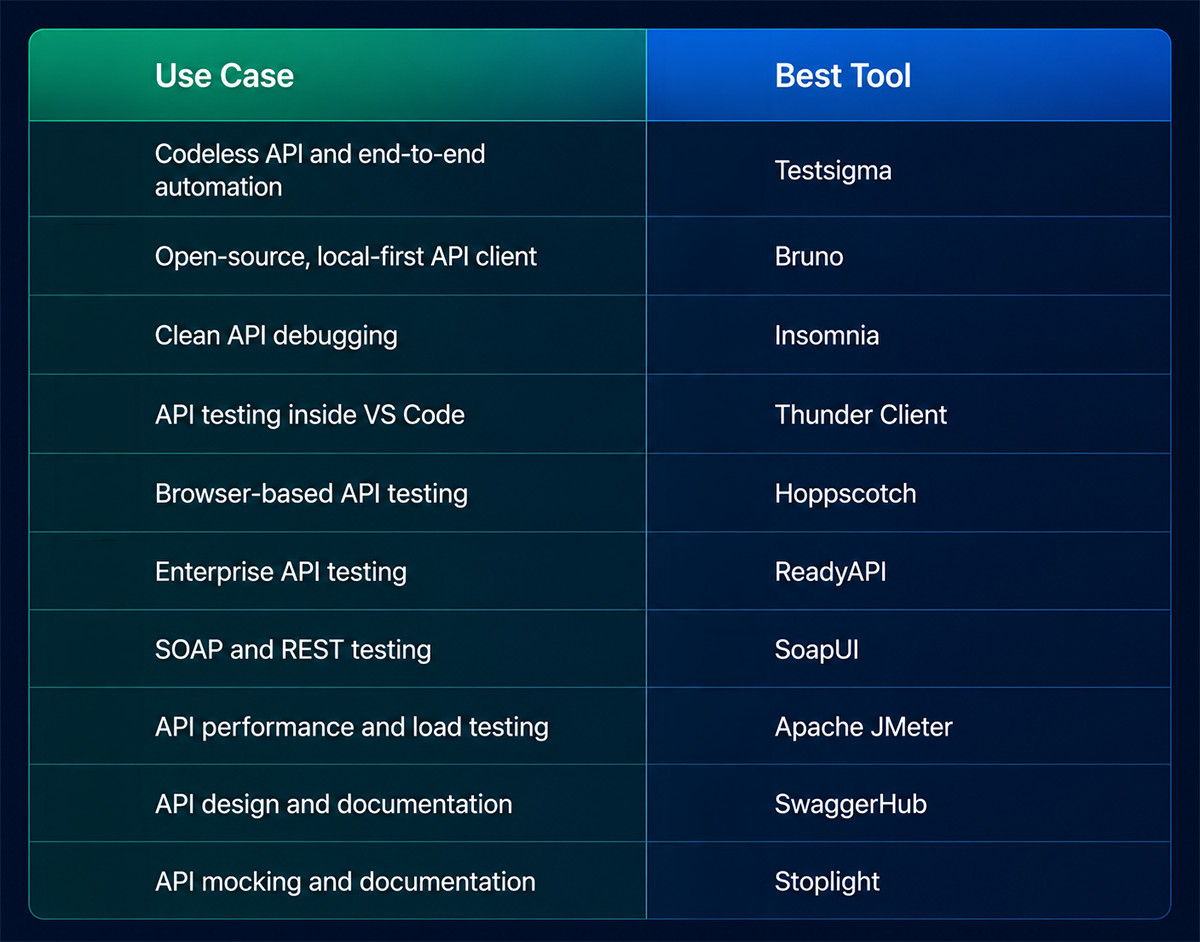
Quick Answer: Best Postman Alternative by Use Case
Why This Conversation Matters in 2026
Two data points set the context.
Postman’s 2025 State of the API Report found that 89% of developers now use AI — but only 24% are actively designing APIs for AI agents. That gap is closing fast, and it means API quality is becoming a prerequisite for AI readiness, not just a backend concern.
Security is the other pressure point. OWASP lists Broken Object Level Authorization as the single greatest API security risk. APIs that expose object identifiers without proper authorization checks create attack surfaces that are difficult to detect through standard functional testing alone.
Both of these trends point in the same direction: API testing needs to go deeper than happy-path validation. And for many teams, that means finding a tool — or a combination of tools — that Postman wasn’t specifically built to provide.
How to Choose the Right Postman Alternative
Before you evaluate tools, answer one honest question: are you replacing an API client, or improving your API testing strategy?
A developer who needs fast endpoint debugging has different requirements from a QA team building automated regression coverage. A performance engineer needs something entirely different from a platform architect managing API governance. Getting clear on the actual job first prevents you from investing in the wrong solution.
The core criteria to evaluate: API protocol support (REST, SOAP, GraphQL, gRPC, WebSocket), automation capabilities, CI/CD integration, collaboration model, documentation support, performance testing, and total cost. We’ll reference these throughout the tool breakdowns below.
The 10 Best Postman Alternatives in 2026
1. Testsigma — Best for Codeless API and End-to-End Test Automation
Most API clients are built for developers exploring endpoints. Testsigma is built for QA teams that need automated coverage.
The practical difference: when a developer tests an API with Postman, they’re checking if it works right now. When a QA team runs Testsigma, they’re validating that it keeps working across every build, in every environment, without manual triggering. Those are fundamentally different jobs.
What makes Testsigma stand out is that API tests don’t live in isolation. A user journey that starts in the UI, triggers an API call, updates backend data, and surfaces a result in a mobile app can be validated as a single end-to-end test. It also supports Postman and Swagger collection import, making migration manageable.
Best for: QA teams, SDETs, and automation engineers who want API testing to support regression coverage and release confidence — not just request-response exploration.
2. Bruno — Best Open-Source Local API Client
Bruno has developed something rare in developer tooling: genuine enthusiasm from its users. The reason is simple — it behaves exactly the way developers want their tools to behave.
Collections live on your machine as plain text files. They sync through Git, not through a proprietary cloud. You own your data completely. There’s no mandatory account, no cloud sync requirement, and nothing pushing you toward a paid tier. When a teammate opens a pull request, the API changes are right there in the diff alongside the code.
It supports REST, GraphQL, gRPC, and WebSocket — covering the vast majority of modern API protocols — and it’s actively maintained by a committed open-source community.
Best for: Developers and engineering teams who want a fast, Git-native API client where collections live with the codebase.
3. Insomnia — Best for Clean API Testing and Debugging
Insomnia’s value proposition is clarity. It’s a polished, multi-protocol API client that doesn’t try to be a full platform.
Protocol coverage is broad — REST, GraphQL, gRPC, SOAP, WebSocket, and SSE are all supported cleanly. That matters because real APIs in 2026 aren’t uniformly REST-over-JSON. Teams building internal gRPC services, flexible GraphQL APIs, or real-time WebSocket features need a client that handles all of it without requiring a separate tool for each case. It also works locally without a mandatory account, which removes friction for privacy-conscious teams.
Best for: Developers and API teams who want a multi-protocol debugging experience that’s clean, flexible, and doesn’t force a cloud-first setup.
4. Thunder Client — Best for VS Code Users
Every context switch between the code editor and an external API client has a cost — broken flow, lost mental context, the overhead of reorienting in a different environment. For developers who test APIs regularly while building, that adds up across a workday.
Thunder Client removes the switch by living directly inside VS Code. You open it from the sidebar, build a request, inspect the response, and return to coding without changing windows. Local storage and Git sync keep collections persistent, and scriptless testing covers basic assertion needs without writing scripts.
Best for: Developers who spend their day in VS Code and want API testing built into the natural development loop, not bolted on.
5. Hoppscotch — Best Browser-Based Postman Alternative
Sometimes the fastest API client is the one that’s already open. Hoppscotch requires no installation, no account, and no setup. You load the app in a browser tab and you’re testing APIs — useful for quick endpoint checks, sharing a request with a colleague, or onboarding someone without IT provisioning.
It’s more capable than it looks: REST, GraphQL, and WebSocket support covers the common cases well. The open-source codebase gives teams with specific requirements the option to fork and customize. With over 5 million requests processed monthly, it’s a well-maintained project with real adoption behind it.
Best for: Developers who want immediate, browser-accessible API testing without installation overhead.
6. ReadyAPI — Best for Enterprise API Testing
There’s a category of API testing requirement that lightweight clients can’t address: proving to a security team, an auditor, or a regulated customer that APIs have been systematically validated for functional correctness, security vulnerabilities, and performance under load.
ReadyAPI is built for that. It supports functional testing, security testing, and load testing across REST, SOAP, GraphQL, WebSocket, and more. The low-code approach makes it accessible to QA teams without deep scripting backgrounds, and CI/CD integrations with Jenkins, Azure DevOps, and GitLab mean test execution runs automatically on every build.
Best for: Enterprise QA teams where API testing is tied to compliance requirements, security obligations, and release readiness evidence.
7. SoapUI — Best for SOAP and REST Testing
SOAP isn’t exciting to talk about, but it runs a lot of things that matter — financial systems, healthcare integrations, government APIs, and enterprise platforms built before REST became the default. Teams that work with those systems need a client that genuinely understands WSDL, SOAP envelopes, and WS-Security.
SoapUI has been the standard for this work for over a decade. The open-source version handles core SOAP and REST testing. It also supports assertions, data-driven testing, API mocking, and imports from WSDL, Swagger, RAML, and Postman collections.
Best for: QA teams that work with SOAP services, legacy enterprise systems, or integration environments where structured API contracts are still the norm.
8. Apache JMeter — Best for API Performance and Load Testing
Most API testing answers a qualitative question: does this endpoint return the right response? JMeter answers a different one: does this endpoint return the right response when five thousand concurrent users are hitting it?
That requires a fundamentally different tool. JMeter simulates configurable virtual users, ramp-up curves, and concurrent request patterns — letting you measure how APIs hold up at production-realistic traffic levels. It supports HTTP, HTTPS, SOAP/REST, JDBC, LDAP, JMS, FTP, and TCP. It’s free, open source, and has a plugin ecosystem that extends it in almost every direction you might need.
Best for: Performance engineers and QA teams who need to validate API scalability and behavior under load, not just functional correctness.
9. SwaggerHub — Best for API Design and Documentation
Before an API can be tested well, it needs to be defined clearly. SwaggerHub is built for that moment — the design phase, where API contracts are written, reviewed, and agreed upon before implementation begins.
Teams following an API design-first approach use SwaggerHub to collaborate on OpenAPI specifications, enforce design consistency through style guides, and generate documentation that stays synchronized with the actual contract. For organizations where multiple teams consume each other’s APIs, that upfront clarity has direct downstream impact on testing, integration, and onboarding.
Best for: API architects and platform teams who want design quality and documentation governance to lead the development lifecycle, not follow it.
10. Stoplight — Best for API Mocking and Documentation
Stoplight solves a specific coordination problem: the backend isn’t finished, so the frontend and QA teams are blocked waiting for something real to test against.
Mock servers change that dynamic. Stoplight generates working mock API endpoints directly from OpenAPI specifications, giving teams something functional to build and test against before implementation is complete. It also produces clean, publishable API documentation from the same source — so design, docs, and mocks all stay in sync.
Best for: Product, frontend, QA, and backend teams that want to work in parallel without waiting for backend completion, and want documentation that reflects the actual API contract.
There’s no single right answer here, and any guide that pretends otherwise is oversimplifying.
If you need a local API client: Bruno. Clean debugging across protocols: Insomnia. VS Code integration: Thunder Client. Zero-install browser testing: Hoppscotch.
For QA automation: Testsigma for codeless end-to-end coverage. ReadyAPI for enterprise functional and security testing. SoapUI for SOAP environments. JMeter for performance. SwaggerHub and Stoplight when design quality and documentation matter as much as testing.
But the tool choice is secondary to the strategy question. The teams that get the most value from any of these tools are the ones that have asked the harder question first: what does good API quality actually look like for our team, and how does testing support the release decisions we need to make?
That’s the conversation worth having — and it’s exactly the kind of question QA leaders and testing professionals tackle at Testingmind events, where practitioners from 4,000+ organizations across 54+ cities discuss what’s actually changing in software quality and how to keep up.
Explore upcoming Testingmind and Test Automation Summit events to learn how QA teams are approaching API testing, automation, AI readiness, and the future of software quality.
FAQs
What is the best Postman alternative in 2026? It depends on your use case. Bruno is the top pick for open-source local API testing. Insomnia is widely used for clean multi-protocol debugging. Testsigma leads for codeless API test automation connected to broader QA workflows. Thunder Client is the go-to for VS Code-based development.
What is the best free Postman alternative? Bruno is the strongest free, open-source option — it’s Git-native, works entirely offline, and stores collections in plain text with no cloud account required. Hoppscotch and Insomnia also have free tiers worth considering.
Which Postman alternative is best for QA teams? Testsigma, ReadyAPI, SoapUI, and Apache JMeter are the strongest options for QA teams — covering codeless automation, enterprise validation, SOAP testing, and performance testing respectively.
Which Postman alternative is best for developers? Bruno for Git-native local workflows, Insomnia for multi-protocol flexibility, Hoppscotch for browser-first simplicity, and Thunder Client for VS Code integration.
Which Postman alternative is best for API performance testing? Apache JMeter is the gold standard for open-source load and performance testing. It supports HTTP, HTTPS, SOAP/REST, JDBC, JMS, and more — and it’s completely free.