Event At a Glance
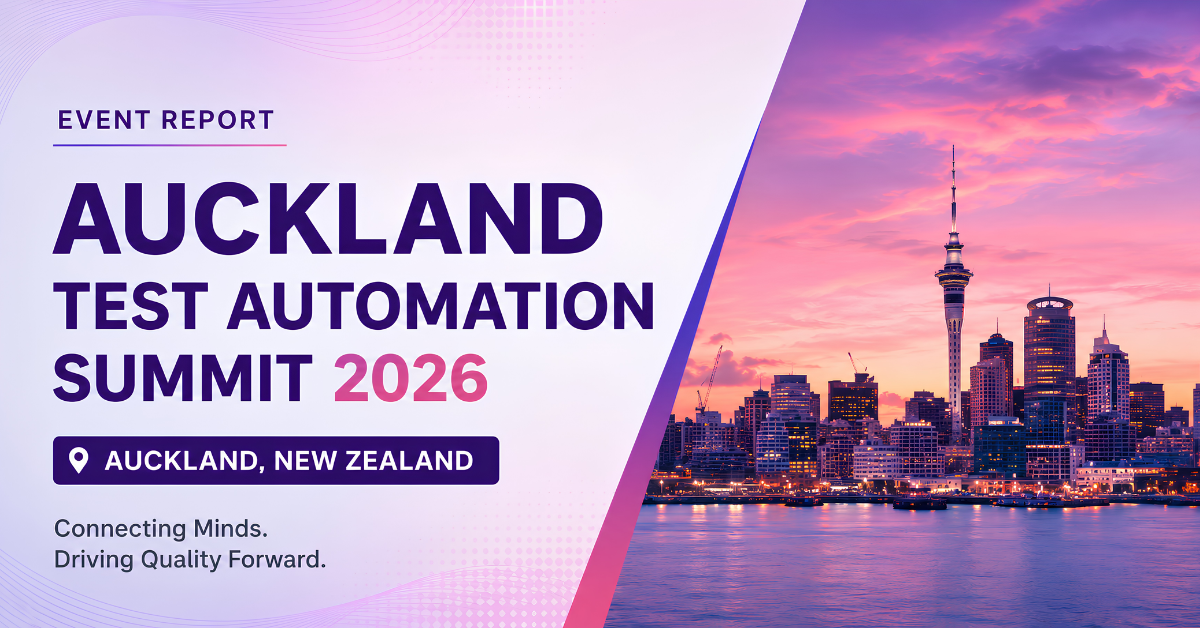
Event: Test Automation Summit Auckland 2026
Theme: Human-Centric Quality: AI-Driven, Sustainable, and Secure Testing for the Digital Era
Date: 14 May 2026
Time: 09:00 AM – 05:00 PM
Venue: SO/ Auckland
Format: 1 Day | 1 Track | 10+ Speakers
Audience: QA leaders, automation specialists, test engineers, developers, consultants, and technology decision-makers
Industries represented: Technology, SaaS, public sector, healthcare, BFSI, telecom, logistics, automotive, IoT, and QA consulting
Core themes: AI in testing, automation strategy, no-code testing, data quality, LLM testing, and the future of QA
Download the full Test Automation Summit Auckland 2026 report with speaker insights, audience breakdown, key themes, and attendee takeaways.
There’s a version of a tech conference you’ve probably attended before. The slides are clean. The coffee is great too. Then the keynote speaker says something vaguely inspiring about “the future of software.” You take a few notes you’ll never open again, collect a tote bag, and head home roughly the same person you arrived as.
The Test Automation Summit in Auckland was not that conference.
On 14 May 2026, Auckland hosted a room full of people who care deeply about software quality — QA engineers, automation specialists, senior test leads, software developers, principal consultants, and general managers — all gathered to wrestle with a question that’s becoming harder to ignore: how do we use AI and automation to actually get better at releasing software, not just faster at producing tests?
What followed was a full day of honest, practical, and thought-provoking conversations. The sessions moved beyond surface-level discussions and focused on the real questions testing teams are facing today: what is working, what needs to change, and where the profession is headed next.
Who Were in the Room
The Auckland summit brought together a focused mix of QA, automation, engineering, and delivery professionals.
Attendee roles included:
- QA and Quality Engineering Roles — Senior Quality Assurance Engineer, Intermediate QA Engineer, Senior QA Analyst, Quality Engineer, Senior QA Engineer, QA Engineer, Quality Assurance Engineer, Software Quality Analyst
- Testing and Test Engineering Roles — Test Analyst, Senior QA Tester, QA Tester, Test Manager, Senior Test Engineer, Senior Test Lead, Test Engineer, Software Tester, Testing Manager, Software Test Engineer, Quality Assurance Test Lead
- Automation and SDET Roles — Test Automation Engineer, Software Development Engineer in Test, Sr. Engineer – Test Automation, Senior test automation engineer, Senior QA Automation, Automation Tester
- Software and Integration Roles — Full Stack Developer, Senior Integration Engineer
- Leadership, Consulting, and Business Roles — Engineering Manager, Principal Consultant, General Manager Northern Region, Senior Consultant, Head of Testing, Business Development Manager, Co-Founder & CEO, General Manager – Sales
This mix made the room highly practical.
Companies represented at the summit
The Auckland summit saw participation from professionals across technology, SaaS, public sector, healthcare, finance, telecom, logistics, automotive, smart home, and QA consulting. The audience mix reflected the growing importance of software quality across industries where reliability, data accuracy, customer experience, and digital trust are business-critical.
Companies represented included
The strength of the attendee mix came from the industries represented. Companies such as Visa, NZTA, TTC Global, Sysmex, Les Mills International, Resideo, Cin7 Ltd, Parts Trader, and many more operate in environments where software quality directly impacts customer experience, data accuracy, operational reliability, compliance, and digital trust.
Industry Breakdown
| Industry Category | Audience Share |
|---|---|
| Technology / SaaS / Digital Platforms | 35.2% |
| Public Sector / Transport / Civic | 13.0% |
| Healthcare / HealthTech / Diagnostics | 11.1% |
| Automotive / Logistics / Supply Chain | 9.3% |
| BFSI / Payments / Insurance / Wealth | 7.4% |
| QA / IT Consulting / Quality Engineering | 7.4% |
| Consumer / Fitness / Lifestyle | 5.6% |
| Smart Home / IoT / Security | 5.6% |
| Independent / Other / Unclassified | 5.6% |
Speaker that Shaped the Day
Keynote Speaker
Deborah Costello
Head of Testing and Environments
QBE NZ
Featured Speakers
Jay Bhati
Test Manager, Tautahi First Fibre
Nelly Sajwan
Test Automation Architect, Spark NZ
Deepthi Thagadegowda
Data Test Lead, Television New Zealand
Tariq Azoor
Principal Consultant, SteadyPay
Tutorial Speaker
Raj Uppadhyay
Engineering Chapter Lead, Woolworths New Zealand
Fireside Speakers (Should go in one slide)
Emma Arceo
Test & Quality Assurance Manager, One New Zealand
Mei Reyes-Tsai
General Manager – Innovation and Technology, TTC Global
Panel Discussion Speakers (Should go in one slide)
Francis Ho
Director of Engineering, Auror
Roger Chong
Practice Manager – Quality Engineering, Auckland Council
Nessta Jones
QA Director, Afor
Royston Raphael
Regional Director of Automation, AI & Data, Planit
Paul Hope
Quality Assurance Practice Lead, Foodstuffs North Island Limited
Have a QA story, framework, or real-world testing lesson worth sharing?
Join the next Auckland edition as a speaker and share your perspective with a room full of QA leaders, automation specialists, and quality engineering professionals.
Why the Auckland Summit mattered
Software teams today face constant pressure to release faster, manage complex systems, and adopt AI without adding new risks. The event explored practical AI adoption, no-code automation, data quality, LLM-powered features, sustainable testing, and the evolving role of testers — all anchored around one central question:
How can QA teams use AI and automation to build stronger confidence in every release?
That’s exactly what made the Auckland summit so relevant for both technical practitioners and quality leaders alike.
Key Themes Discussed
1. Testing is moving closer to business confidence
The Auckland summit made it clear that QA is no longer just the team that finds defects at the end of a release cycle. Deborah Costello’s keynote framed testing as a function that now helps teams build trust, reduce uncertainty, and make better release decisions. For QA teams, this means the role is becoming more strategic: testers are expected to understand risk, user impact, system behavior, and business confidence — not just test execution.
2. AI is changing how testing work gets done
AI was discussed as something that can support test creation, documentation, feedback loops, data validation, pattern detection, and predictive testing. Deepthi Thagadegowda’s session showed how AI can make testing more proactive and insight-driven, especially in complex data environments. The real takeaway for teams is that AI is not just another tool to add to the stack. It is changing how testing is planned, maintained, reviewed, and improved.
3. Human judgement is becoming more important, not less
One of the strongest messages from the summit was that AI can assist testers, but it cannot replace the judgement testers bring. Deborah’s slides positioned AI as an amplifier of human insight, while Nelly Sajwan’s session showed why AI-generated automation still needs ownership and review. For QA teams, this is an important shift: the future tester is not just someone who runs tests, but someone who questions results, understands risk, and decides what quality really means in context.
4. More tests do not automatically mean better quality
Nelly Sajwan’s session challenged the idea that test count, coverage percentage, and green pipelines are enough to prove quality. Her deck made a strong point: automation only creates value when it helps teams make better decisions. This is a practical takeaway for every QA team — instead of asking “how many tests do we have?”, teams need to ask “which risks are these tests helping us understand?”
5. Automation needs stronger ownership and governance
As AI makes test creation faster, the risk of creating low-value test debt also increases. Nelly’s session showed how AI-generated tests can create duplication, weak assertions, flaky fixes, and false confidence if teams do not have clear review practices. For readers, this is one of the most useful lessons from the summit: automation needs owners, decision rules, and regular cleanup — otherwise it becomes noise.
6. No-code automation can bring more people into quality
Jay Bhati’s session showed how no-code automation can reduce dependency on coding-heavy QA skills and help domain experts participate more actively in testing. This matters because many teams struggle with automation maintenance, specialist skill gaps, and slow onboarding. No-code testing does not remove the need for QA expertise, but it can make quality more collaborative by allowing more people to contribute to what should be tested.
7. Data quality is now part of software quality
Deepthi Thagadegowda’s session brought attention to a reality many teams are already facing: modern systems are powered by data pipelines, dashboards, transformations, and analytics. If the data is wrong, delayed, incomplete, or inconsistent, the business impact can be serious. This theme showed that QA teams now need to think beyond application behavior and include data accuracy, completeness, consistency, timeliness, and pipeline reliability as part of quality.
8. AI-native products need a different testing mindset
The Auckland agenda included a session on testing LLM-powered features, showing that QA teams are now entering a new kind of testing challenge. AI-native products cannot always be tested with traditional pass/fail checks alone. Teams need to think about behavior, context, safety, trust, misuse scenarios, and output quality. This is especially important as more products begin embedding AI into customer-facing experiences.
9. Sustainable and secure testing are now part of modern QA
Deborah’s deck connected quality with sustainability, security, ethical judgement, team wellbeing, and long-term maintainability. This gave the summit a broader view of QA: quality is not only about speed or coverage, but also about building systems that remain reliable, safe, and manageable over time. For teams, this means reducing brittle test suites, late-stage rework, burnout, and security blind spots should also be seen as quality goals.
10. The future of QA is human-led and AI-assisted
Across the Auckland sessions, the bigger message was consistent: AI will change testing, but people will continue to define quality. Whether the discussion was about no-code automation, data testing, LLM-powered features, governance, or sustainable testing, the summit pointed to the same future — one where AI accelerates the work, but testers still shape the decisions, the risks, and the confidence behind every release.
Want to explore the sessions in more detail?
Access the speaker presentations from TAS26 Auckland and revisit the ideas shared across AI testing, automation strategy, data quality, no-code testing, and the future of QA.
What Hit Home for Attendees
“The sessions on emerging trends, AI in testing, and modern quality practices were particularly beneficial and helped broaden my perspective on evolving industry standards.” – Jenifar Parmar – QA Tester, BidOne
“I really liked the live demo on creating test plans and test scripts—it clearly demonstrated how the Democratize Quality MCP Server empowers broader participation in quality and automation.” – Swetha Adepu – Quality Assurance Engineer, Freightways Information Services
“Hearing about AI, not just how wonderful it is but pitfalls as well. Liked the talk on non coding testing, pitching alternative ideas.” – Priya Singh – Software Tester , Sysmex
“Learning about automation self healing and decision matrix for test cases.” – Karma Yangchen Gurung – Senior QA Engineer, Cin7 Ltd
“Ideas to spark conversations with colleagues that I went with. Refocus on what responsibilities and focus we should have as test engineers. Discussion on strategies and interactions with developers and project managers.” – Tony Kuo – Test Automation Engineer, MEDTECH
What Attendees Thought of the Event
Based on the attendee feedback, the Auckland summit was seen as a practical, relevant, and energizing event that helped participants think more clearly about the future of QA, AI, and automation.
The Attendees
- found the sessions highly practical and usable.
- appreciated the balanced view of AI.
- felt the event helped them rethink their role as test engineers.
- valued the exposure to modern QA trends.
- enjoyed the networking and community experience.